
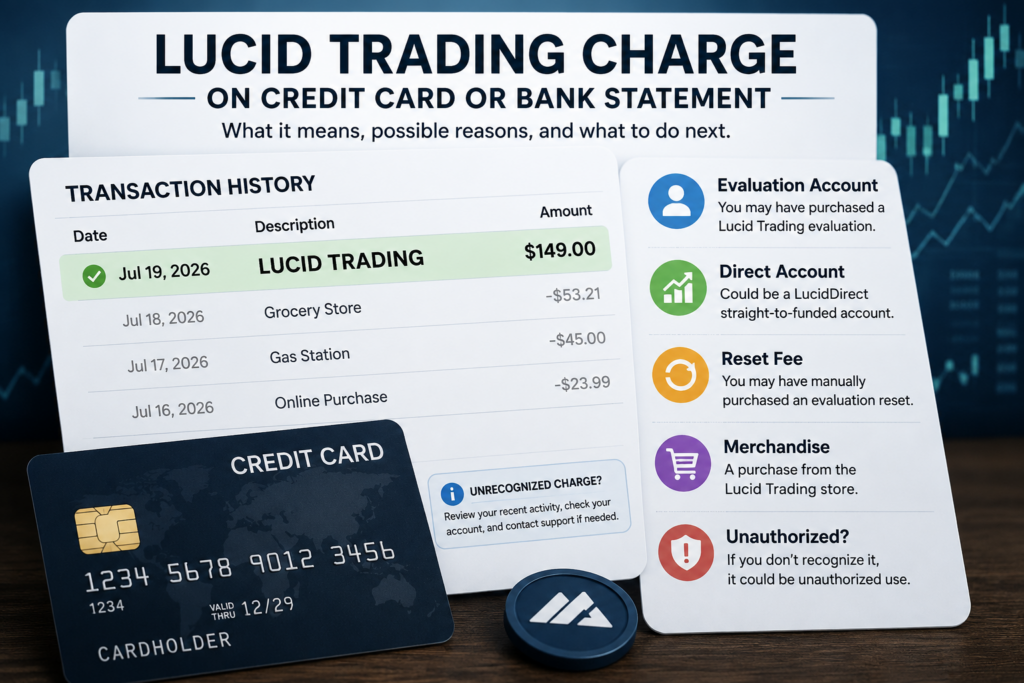
A Lucid Trading charge, LUCIDTRADING.COM charge, or similar Lucid entry on a credit card, debit card, or bank statement usually represents a futures evaluation account, straight-to-funded account, manually purchased reset, or another purchase made through LucidTrading.com.
What Is the Lucid Trading Charge?
A Lucid Trading card charge is commonly associated with Lucid Trading Group LLC, a company offering simulated futures-trading evaluations, funded-account programs, and paths to live trading.
The payment may represent:
- A LucidPro Evaluation account
- A LucidFlex Evaluation account
- A LucidDaily Evaluation account
- A LucidDirect straight-to-funded account
- An eligible LucidMaxx purchase
- Another current or legacy Lucid account product
- A manually purchased evaluation reset
- More than one trading account purchased separately
- A merchandise purchase from the Lucid Trading store
- A purchase made by another authorized card user
- Fraudulent or unauthorized use of the payment card
Verify the exact product, purchaser, account size, amount, and order date through the Lucid Trading portal and the purchase-confirmation email.
Possible Lucid Trading Statement Descriptors
The wording can vary according to the payment processor, card network, bank, and amount of space available on the statement.
Possible variations include:
- LUCID TRADING
- LUCIDTRADING.COM
- LUCID TRADING GROUP LLC
- LUCID TRADING STORE
- PENDING LUCID TRADING
- CHECKCARD LUCID TRADING
- CHKCARD LUCIDTRADING.COM
- POS DEBIT LUCID TRADING
- POS PURCHASE LUCID TRADING
Not every variation above has been independently confirmed as a current merchant descriptor. Banks sometimes add card-type, transaction-status, or payment-method wording.
Copy the complete transaction exactly as displayed when contacting Lucid Trading or the card issuer. Do not post a complete transaction reference, card number, or other private banking information in a public comment.
Why Did Lucid Trading Charge My Credit or Debit Card?
The charge may have resulted from:
- Purchasing a new evaluation account
- Purchasing a straight-to-funded account
- Manually resetting an eligible evaluation
- Purchasing more than one account
- Selecting a different account size or program
- Buying merchandise from the Lucid Trading store
- A purchase by a family member or other card user
- A pending authorization followed by a completed transaction
- A duplicated payment
- Unauthorized use of the card
The amount alone may not identify the purchase because account pricing can vary by program, account size, customization, reset eligibility, and current promotion.
Is Lucid Trading a Monthly Subscription?
Lucid Trading currently says its trading accounts use one-time fees without monthly subscriptions.
Its current official information states that:
- LucidPro accounts use a one-time fee without monthly rebilling.
- LucidFlex accounts use a one-time fee without monthly rebilling.
- LucidDaily accounts use a one-time fee without monthly rebilling.
- LucidDirect accounts use a one-time fee without automatic rebilling.
- Eligible evaluation resets must be purchased manually.
- Resets are not automatic or free.
- There is no activation fee when an eligible evaluation advances to its funded account.
Review the official Lucid Trading FAQ and the terms presented during checkout for the exact product purchased.
What Lucid Trading Products Can Cause a Charge?
LucidPro Evaluation
A LucidPro charge may represent a one-time payment for an evaluation account. The trader attempts to meet the applicable profit objective and account rules before becoming eligible for a LucidPro Funded account.
Lucid says there is no separate activation fee to advance from a passed LucidPro Evaluation to a LucidPro Funded account.
LucidFlex Evaluation
A LucidFlex charge may represent a one-time evaluation purchase. LucidFlex may include selectable account features, so prices can differ according to the account size and configuration chosen during checkout.
LucidDaily Evaluation
LucidDaily is a newer evaluation product offering daily payout eligibility after reaching the funded stage. Its evaluation includes customizable settings that may affect the purchase price.
Lucid says LucidDaily uses a one-time fee without monthly rebilling and does not charge an activation fee when an eligible evaluation advances to a funded account.
Review the LucidDaily Evaluation information if the transaction occurred after this product became available.
LucidDirect Account
A LucidDirect charge may represent the purchase of a simulated straight-to-funded account that does not require completion of a separate evaluation.
Match the payment with:
- The selected LucidDirect account size
- The order-confirmation email
- The Lucid Trading dashboard
- The account-activation notice
- The date the account became available
LucidMaxx
LucidMaxx is an exclusive evaluation-to-live program that is not generally available to every customer. Lucid says it can only be purchased by traders who have earned LucidMaxx status through qualifying performance.
If the cardholder participates in LucidMaxx, compare the transaction with the evaluation tier, account size, and order history. Most consumers without LucidMaxx eligibility would not ordinarily have a legitimate charge for this program.
Lucid Trading Merchandise
Lucid operates a separate online merchandise store. A clothing, accessory, or other merchandise purchase may create a Lucid-related card entry that is separate from a trading account.
Check store confirmations, shipping notices, and receipts when the payment does not match an account purchase.
What Is a Lucid Trading Reset Fee?
A reset fee may appear when an eligible evaluation account is manually restarted through the trader dashboard.
A reset generally:
- Is a separate purchase
- Must be selected manually
- Is not automatically applied
- Is not included free with the original purchase
- Returns an eligible evaluation to its starting conditions
- May have pricing based on the account product and size
Lucid’s current guidance says resets are available for evaluation accounts but not funded accounts. Review the dashboard and order history to determine whether a reset was purchased shortly before the transaction.
Why Are There Multiple Lucid Trading Charges?
More than one Lucid Trading entry may result from:
- Multiple accounts purchased separately
- Different account sizes or programs
- A new evaluation followed by a manually purchased reset
- Purchases made by different household members
- A pending authorization and completed transaction
- A failed payment attempt followed by an approved payment
- An account purchase and separate merchandise order
- A duplicate completed transaction
- Repeated fraudulent use of the card
Compare the number of completed charges with the number of orders, active accounts, and purchased resets. A pending transaction and a matching completed charge do not always represent two final payments, but two completed charges should be investigated.
What Cards Does Lucid Trading Accept?
Lucid Trading currently says it accepts the following payment cards for accounts and services:
- Visa
- Mastercard
- American Express
- Discover
- Diners Club
- Maestro
See the official accepted payment methods for current information.
Acceptance of a card type does not prove that a particular transaction was authorized by the cardholder.
Can a Family Member Use My Card for Lucid Trading?
Do not assume that the use of a shared household card automatically complies with Lucid’s account and payment requirements.
When another person may have made the purchase:
- Identify who created the trading account.
- Determine which email address was used.
- Compare the payment with that person’s order history.
- Confirm whether the cardholder gave permission.
- Contact Lucid support if the trader and cardholder information differ.
A purchase can be recognized by a family member but still create an account-compliance problem if the payment or identity information does not meet Lucid’s requirements.
How to Verify a Lucid Trading Charge
- Open the complete transaction. Record the descriptor, amount, date, and whether it is pending or completed.
- Search your email. Look for Lucid Trading receipts, account activations, resets, and merchandise confirmations.
- Sign in through the official website. Review the Lucid dashboard, active accounts, and available order information.
- Check for a reset. Determine whether an eligible evaluation was manually restarted.
- Compare the amount. Match it with the receipt, product, account size, and configuration.
- Ask authorized users. A family member or employee may recognize the purchase.
- Contact Lucid Trading. Ask the company to identify the product and order connected with the payment.
- Contact the issuer. Report the transaction promptly if no authorized purchase can be found.
Useful email-search terms include:
- Lucid Trading
- LucidPro
- LucidFlex
- LucidDaily
- LucidDirect
- LucidMaxx
- Evaluation
- Account reset
- Account activation
- Order confirmation
- The exact transaction amount
How to Review Lucid Trading Order History
Use the official account portal to compare the payment with:
- Order dates
- Purchased products
- Account sizes
- Account customizations
- Reset purchases
- Account status
- Activation information
Visit the official Lucid Trading account portal.
Always reach the portal through LucidTrading.com rather than a link from an unexpected email, text message, advertisement, or social-media account.
What Is Lucid Trading’s Refund Policy?
Lucid Trading publishes a strict refund policy.
The current policy generally states that:
- An account that has been traded is not eligible for a refund.
- Any trading activity may end refund eligibility.
- A never-traded account may be considered for a refund at Lucid’s discretion.
- Exceptional circumstances may be considered at the company’s discretion.
- Account violations, disqualifications, and rule breaches generally do not qualify.
- Access to the purchased service may be treated as completion of the service.
Review the complete current policy before requesting a refund:
Lucid Trading refund and chargeback policy.
How to Request a Lucid Trading Refund or Billing Correction
Contact Lucid promptly when:
- The wrong account or account size was purchased
- A duplicate completed payment appears
- The order was created accidentally
- The account has never been traded
- The purchased account was not delivered or activated
- The amount differs from the receipt
- No order can be matched with the payment
- Do not trade an account while seeking a refund for that purchase.
- Save the receipt and order confirmation.
- Open a support request through the official website.
- Provide the order number, account email, amount, and date.
- Explain whether the issue involves a duplicate, incorrect amount, wrong product, or unknown purchase.
- Request written confirmation of the company’s decision.
- Save all support messages and screenshots.
Suggested Lucid Trading Billing Message
I am contacting you about a Lucid Trading charge dated [date] for [amount]. The account email is [email], and the order number is [number, if known]. Please identify the product, account size, and whether the payment was an account purchase, reset, or other order. The issue is [brief explanation]. Please confirm whether a correction or refund is available.
Do not provide a complete card number, CVV, PIN, password, trading credentials, or authentication code.
Lucid Trading Chargebacks and Account Restrictions
Lucid’s policy warns that a chargeback it considers fraudulent, unfounded, or improper may result in permanent loss of access, account restrictions, and attempts to recover the disputed payment and related costs.
This does not mean a cardholder should ignore genuinely fraudulent charges.
- Authorized purchase or refund disagreement: Contact Lucid first and follow its billing or refund process.
- Duplicate payment or incorrect amount: Ask Lucid to investigate and retain its written response.
- Truly unauthorized transaction: Notify the card issuer promptly and tell Lucid that the cardholder did not create or authorize the order.
Never knowingly misrepresent an authorized purchase as fraud to bypass a merchant’s refund policy.
Is a Lucid Trading Credit Card Charge Fraudulent?
Not automatically. Lucid Trading is an identifiable company, and the charge may correspond to a legitimate evaluation, funded account, reset, or merchandise purchase.
However, a transaction from a real merchant can still be unauthorized if another person used the card without permission.
Warning signs include:
- No household member recognizes Lucid Trading
- No Lucid account or order confirmation can be found
- Several unfamiliar Lucid payments appear close together
- The same completed payment appears more than once
- The card was recently lost or stolen
- Other unrelated fraudulent charges are appearing
- Lucid cannot match the transaction with an order
What to Do About an Unauthorized Lucid Trading Charge
- Save the full descriptor, amount, and date.
- Determine whether the transaction is pending or completed.
- Ask household members and other authorized card users.
- Search relevant email accounts for Lucid orders.
- Check the Lucid portal for unfamiliar accounts or purchases.
- Ask Lucid support to identify the order.
- State clearly if the cardholder did not authorize the purchase.
- Lock the card if additional suspicious transactions are appearing.
- Notify the bank or card issuer promptly.
- Ask whether the card number or digital payment token should be replaced.
A legitimate merchant name on the statement does not establish that the cardholder personally authorized the transaction.
Current Lucid Trading Contact Information
- Business: Lucid Trading Group LLC
- Official website: LucidTrading.com
- Help Center: Lucid Trading Help Center
- Contact and live chat: Contact Lucid Trading
- Published email: support@lucidtrading.com
- Published support availability: 24-hour support Monday through Friday
- Typical published response time: Two to four hours
- Published mailing address: 3500 S. Dupont Highway, Dover, DE 19901
No verified public customer-support telephone number was found on the official Lucid Trading pages reviewed. Use the official website, live chat, or support system rather than an unverified number found in a search result, forum, or social-media post.
Is This Charge From Lucidchart or Lucidspark?
Lucid Trading is different from Lucid Software, the company associated with Lucidchart and Lucidspark.
An invoice or account page referring to Lucidchart, Lucidspark, diagrams, visual collaboration, Lucid Software, or “Plans & Billing” likely concerns the separate software company.
Review Lucidchart and Lucidspark billing help.
Is This Charge From Lucid Motors?
Lucid Trading is also separate from Lucid Motors, the electric-vehicle manufacturer.
Review every word in the descriptor, the amount, receipt, confirmation email, and merchant website before contacting a company solely because its name contains “Lucid.”
Credit Card Dispute Guidance
Contact the credit-card issuer promptly when:
- No authorized Lucid Trading order can be identified
- The card was used without permission
- A duplicate completed charge is not corrected
- The amount differs from the receipt
- Lucid cannot locate the transaction
Use the issuer’s official dispute procedure, follow up in writing when required, and keep the receipt, account history, support request, and merchant response.
Review CFPB credit-card dispute guidance.
Debit Card and Bank Account Guidance
Report an unauthorized debit-card or bank transaction immediately. Debit-card and credit-card protections, procedures, and deadlines are different.
Ask the bank:
- Whether another authorization is pending
- Whether the debit card should be replaced
- Whether a digital payment token was used
- Whether additional merchant information is available
- What documentation is required
Review CFPB unauthorized debit and bank-transaction guidance.
Watch Out for Fake Lucid Trading Support
Use LucidTrading.com, the official Help Center, or support tools reached directly through the company’s website.
Be suspicious of anyone who:
- Contacts you unexpectedly offering a guaranteed refund
- Requests payment to cancel or investigate an account
- Asks for a complete card number
- Requests a PIN, CVV, password, or authentication code
- Wants remote access to a computer or phone
- Requests cryptocurrency or gift cards
- Promises guaranteed trading profits
- Claims money must be transferred to a “safe account”
Frequently Asked Questions
What is Lucid Trading on my credit card statement?
It may represent a futures evaluation, straight-to-funded account, manually purchased evaluation reset, merchandise order, or another purchase made through LucidTrading.com.
Does Lucid Trading charge monthly?
Lucid’s current official information says its trading accounts use one-time fees without monthly subscriptions or automatic rebilling.
What is a Lucid Trading debit-card charge?
It may represent the same account, reset, or merchandise purchases available through Lucid Trading. Lucid says it accepts several major debit and credit card types.
Can Lucid Trading automatically reset an account?
Lucid says eligible evaluation resets must be purchased manually and are not automatic or free.
Does Lucid charge a funded-account activation fee?
Lucid currently says eligible evaluation products do not have a separate activation fee when advancing to their corresponding funded accounts.
Why did I receive two Lucid Trading charges?
Possible explanations include two account purchases, a manually purchased reset, a pending and completed entry, merchandise, a duplicate transaction, or unauthorized card use.
Can I receive a Lucid Trading refund?
Lucid says traded accounts are not refundable. It may consider a never-traded account or exceptional circumstances at its discretion.
Will a chargeback get my Lucid account banned?
Lucid warns that fraudulent or improper chargebacks may result in a permanent ban. Contact Lucid first for an authorized-purchase disagreement, but notify the issuer promptly when the card was genuinely used without permission.
Is Lucid Trading credit card fraud?
The appearance of Lucid Trading does not automatically mean fraud. Treat it as potentially fraudulent if no authorized user recognizes the transaction and no matching order can be found.
Is Lucid Trading the same as Lucidchart?
No. Lucid Trading is separate from Lucid Software, Lucidchart, and Lucidspark.
Is Lucid Trading the same as Lucid Motors?
No. Lucid Trading is not the electric-vehicle manufacturer.
Related Charge Guides
- How to Investigate an Unrecognized Credit Card, Debit Card, or Bank Charge
- Credit Card Charge Codes and Statement Descriptors
Help Other Cardholders Identify Lucid Trading
If you saw LUCID TRADING, LUCIDTRADING.COM, LUCID TRADING GROUP LLC, or another variation, please share what the payment represented.
Helpful details include:
- The descriptor without private reference numbers
- The approximate amount
- The account product or size
- Whether it was an evaluation, direct account, or reset
- Whether the payment repeated
- Whether the account had been traded
- Whether Lucid approved a correction or refund
- How the issuer resolved an unauthorized payment
Privacy warning: Do not post card numbers, card digits, account email addresses, order numbers, trading credentials, bank details, passwords, PINs, CVV codes, identification documents, or authentication codes.
Why Trust ChargeOnMyCard.com?
ChargeOnMyCard.com researches confusing credit-card, debit-card, and bank-statement descriptors using current merchant information, official policies, consumer-protection guidance, and carefully attributed cardholder reports.
We distinguish Lucid Trading’s published billing model from the separate question of which account, reset, purchaser, duplicate payment, or unauthorized user caused a specific transaction.
ChargeOnMyCard.com cannot access a private Lucid account, identify a cardholder, issue a refund, cancel a trading account, or determine whether a particular payment was authorized.
Last reviewed: August 17, 2026
ChargeOnMyCard.com is not affiliated with Lucid Trading Group LLC, Lucid Software, Lucidchart, Lucidspark, Lucid Motors, any trading platform, cardholder, bank, credit union, card network, or payment processor. This article is for general informational purposes and is not financial, investment, futures-trading, legal, tax, refund, dispute, or fraud-prevention advice.