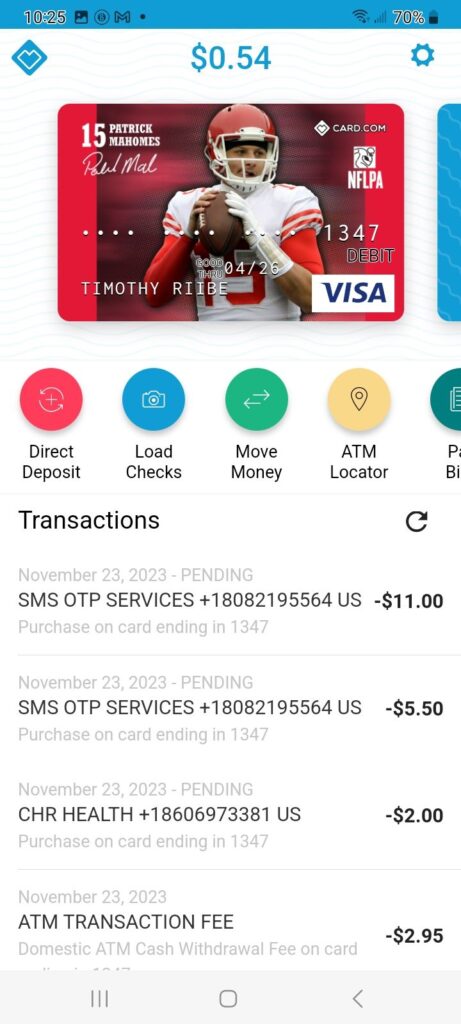
An SMS OTP Service charge on your credit card, debit card, or bank statement may be connected to a telephone-verification service, virtual-number purchase, account-balance deposit, or another service used to receive one-time passcodes by text message.
One strong historical lead is DaisySMS, particularly when the transaction includes 808-219-5564, DSMSOTP, or wording similar to DSMSOTP*BALANCEDEPOSIT. However, at this time, we could not verify a single official company, website, phone number, or address that clearly explains every SMS OTP SERVICE charge.
What Is the SMS OTP Service Charge?
An SMS OTP Service charge on a credit card may involve a website that sells temporary or virtual telephone numbers for receiving SMS verification codes.
Possible explanations include:
- A deposit into a DaisySMS or similar verification-service account
- A purchase of temporary telephone-number access
- A balance refill used to receive verification texts
- Several individual balance deposits
- A payment made through a second account or email address
- A purchase made by another authorized cardholder
- A pending card authorization
- A duplicate or retried balance deposit
- An unauthorized use of the card
The descriptor alone does not identify the website account, telephone number rented, verification service selected, amount added to the balance, or person who submitted the card payment.
What Does SMS OTP Mean?
SMS means Short Message Service, commonly called a text message. OTP means one-time password or one-time passcode.
An OTP is a temporary code sent to a telephone number to confirm a login, account registration, password reset, purchase, or other action.
Receiving a normal verification code from your bank, email provider, social network, or another account does not ordinarily create a separate consumer card charge. A statement charge containing SMS OTP more likely involves paying a business that provides messaging, telephone-number rental, or verification services.
Is the SMS OTP Charge From DaisySMS?
It may be, particularly when the transaction includes 808-219-5564, DSMSOTP, DSMSOTP BALANCE DEPOSIT, or similar wording.
DaisySMS operated a service that provided temporary U.S. telephone numbers for receiving SMS verification codes. Users maintained an account balance and spent that balance when renting numbers for supported websites and apps.
Possible DaisySMS-related statement variations include:
- SMS OTP SERVICE
- SMS OTP SERVICES
- SMS OPT SERVICES
- DAISYSMS
- DAISY SMS
- DSMSOTP
- DSMSOTP*BALANCEDEPOSIT
- DSMSOTP BALANCE DEPOSIT
- DSMSOTPBALANCEDE
- DSMSOTPBALANCEDE 8082195564 NY
- SMS OTP SERVICE 808-219-5564
- PENDING SMS OTP SERVICE
- DEBIT CARD SMS OTP SERVICE
Statement wording may be shortened by the bank or payment processor. Ask the card issuer for the complete merchant descriptor when part of the text is missing.
Did DaisySMS Shut Down?
Yes. The current DaisySMS website states that the service shut down on March 26, 2026. It also says that new registrations and balance top-ups were disabled before the closure.
An older transaction may still represent a historical DaisySMS balance deposit. A new transaction dated after the shutdown should be investigated carefully rather than automatically assumed to be a valid new DaisySMS purchase.
Possible explanations for a later entry could include:
- A delayed or corrected posting of an older transaction
- A bank displaying an older transaction date incorrectly
- A refund, reversal, or adjustment
- A different merchant using similar wording
- Unauthorized activity
What Is 808-219-5564?
The telephone number 808-219-5564 has appeared in cardholder reports and historical DaisySMS account materials.
It may appear in descriptors such as:
- SMS OTP SERVICES 8082195564
- DSMSOTPBALANCEDE 8082195564 NY
- DSMSOTP*BALANCEDEPOSIT
We could not confirm that the telephone number remains active or that it currently provides support. Do not send sensitive account or card information to a number merely because it appears in an old statement or archived screenshot.
Is SMS OTP Service the Same as SMSGlobal?
We found no reliable evidence confirming that every SMS OTP Service charge belongs to SMSGlobal.
SMSGlobal is a separate business-messaging provider that offers SMS gateways and one-time-password services to companies. The fact that it provides OTP technology does not establish that it processed this card descriptor.
The old version of this article listed SMSGlobal’s address and an incorrect telephone number as though they were confirmed merchant information. Those details have been removed to avoid directing readers to a possibly unrelated company.
Why Did SMS OTP Service Charge My Card?
You Added Money to a Verification-Service Balance
Some virtual-number and verification services require users to deposit funds before renting a telephone number. The card transaction may show the balance-deposit descriptor rather than the name of the website feature purchased later.
You Made Several Separate Deposits
A user may add small amounts several times rather than making one large purchase. Each deposit can create a separate card transaction.
A Deposit Was Retried
A declined or interrupted payment may be attempted again. One entry may remain pending while another completes successfully.
Someone Else Used the Card
A household member, employee, contractor, developer, or another authorized user may have used the card to purchase virtual-number or account-verification services.
The Card Was Used Without Permission
If no account, receipt, browser history, authorized user, or verification-service purchase explains the payment, the card details may have been used without authorization.
Why Are Several SMS OTP Charges Pending?
A pending transaction is an authorization that has not yet completed. It may later post, change amount, reverse, or disappear.
Several pending entries may represent:
- Several individual account-balance deposits
- Repeated attempts after a declined payment
- Temporary card-verification holds
- A payment submitted more than once
- Unauthorized testing of the card
Record each pending transaction and ask the card issuer whether the merchant submitted a completed charge. Pending entries usually cannot be disputed in exactly the same way as posted transactions, but the issuer can still help secure the card when unauthorized activity is suspected.
How to Verify an SMS OTP Service Charge
- Copy the complete descriptor exactly as shown.
- Record the amount, transaction date, posting date, and whether it is pending or completed.
- Check whether 808-219-5564, DSMSOTP, DaisySMS, or BALANCEDEPOSIT appears anywhere in the details.
- Search every email account for DaisySMS, SMS OTP, virtual number, verification, balance deposit, payment, receipt, and 3DS.
- Review browser history for DaisySMS or other temporary-number websites.
- Check saved passwords for SMS-verification and virtual-number accounts.
- Review text messages for card-payment or 3-D Secure approval codes.
- Ask household members, employees, developers, and authorized card users.
- Check payment wallets and virtual cards connected to the account.
- Ask the bank for the expanded merchant name, merchant ID, telephone number, location, transaction reference, and recurring-payment indicator.
- Compare those details with any receipt or account you locate.
How to Contact DaisySMS About an Older Charge
DaisySMS no longer operates its former verification service. Its current website directs questions to:
- Current published email: support@daisysms.com
- Current website notice: DaisySMS shutdown information
Response availability is not guaranteed following the shutdown. Include only the minimum information needed to locate the transaction:
- The transaction date
- The amount
- The complete statement descriptor
- The account email, when known
- The last four card digits only when requested through the official email
Do not send a complete card number, CVV security code, bank password, email password, PIN, API key, or one-time verification code.
What If You Never Used DaisySMS?
The descriptor may involve another SMS-verification provider or unauthorized activity. At this time, we cannot confirm that every transaction containing SMS OTP or DSMSOTP belongs to DaisySMS.
- Search for other virtual-number and SMS-verification services.
- Check whether a developer, employee, or contractor used the card.
- Review browser and email history from the transaction date.
- Ask the issuer whether the merchant name expands to DaisySMS or another company.
- Report the transaction promptly if no authorized purchase explains it.
What to Do About an Unauthorized SMS OTP Charge
- Lock the affected card when that option is available.
- Contact the issuer using the number on the card or official banking app.
- Report every unrecognized completed transaction.
- Ask whether additional attempts or pending charges are present.
- Ask the issuer for the merchant ID and expanded transaction information.
- Follow the credit- or debit-card dispute procedure promptly.
- Ask whether the card or underlying account should be replaced.
- Change passwords for any email or verification account that may be compromised.
- Review other accounts for unfamiliar logins and verification messages.
- Continue monitoring for related descriptors and small test charges.
Never Share an OTP or Verification Code
An OTP is intended to prove that the person entering it has access to the registered telephone number or account.
Do not share an OTP with someone who calls or messages claiming to represent:
- Your bank or card issuer
- A fraud department
- A payment service
- A telephone company
- A marketplace buyer or seller
- A technical-support representative
A person asking you to read back a one-time verification code may be attempting to access your account, reset a password, authorize a transaction, or register another account using your telephone number.
Consumer Reports and Experiences
There are currently three visible cardholder reports on this page.
- One visitor reported an alleged unauthorized loss of $426.
- One reported a debit-card entry described only as “SMS opt services.”
- One reported pending charges totaling $209.70 over two days, with 808-219-5564 and New York in the transaction information.
These are individual cardholder reports. They do not establish that every SMS OTP Service charge is unauthorized, that all three transactions came from DaisySMS, or that every similar descriptor belongs to the same company.
Frequently Asked Questions About SMS OTP Service Charges
What is SMS OTP Service on my credit card?
It may be a deposit or purchase involving a virtual-number or SMS-verification service. DaisySMS is one possible historical source when the transaction contains DSMSOTP or 808-219-5564.
What does OTP mean?
OTP means one-time password or one-time passcode. It is a temporary code used to verify a login, account registration, password reset, or transaction.
Does receiving an OTP text cost my credit card?
Normally, receiving a standard account-verification text does not create a separate card transaction. The charge may instead involve paying for a verification-service account or temporary telephone number.
What is DSMSOTP?
DSMSOTP may be shortened payment-descriptor wording associated with DaisySMS or an SMS-verification balance deposit.
What is DSMSOTP Balance Deposit?
It may represent money added to an account balance used to rent temporary telephone numbers for receiving verification messages.
What is 808-219-5564?
The number has appeared in historical DaisySMS materials and cardholder reports. We could not verify that it remains active or provides current support.
Is SMS OTP Service the same as SMSGlobal?
We found no reliable evidence confirming that connection. SMSGlobal provides OTP technology, but that does not prove it used this statement descriptor.
Did DaisySMS close?
Yes. The current DaisySMS website says the service shut down on March 26, 2026.
Why do I have several SMS OTP charges?
They may be separate account deposits, payment retries, pending authorizations, purchases by another card user, or unauthorized transactions.
How do I dispute the charge?
First search for verification-service accounts, receipts, browser history, and authorized users. Contact the card issuer promptly when no authorized payment explains the transaction.
Should I call the number shown on the statement?
Ask the bank whether the number is current before providing information. Never give an unverified caller your complete card number, password, PIN, security code, or OTP.
Related Charge Guide
Digital-service descriptors can show a shortened company name, account deposit, payment processor, telephone number, or product category instead of the website name a cardholder remembers.
Help Other Cardholders Identify This Charge
If you saw SMS OTP SERVICE, SMS OPT SERVICES, DSMSOTP, DSMSOTP*BALANCEDEPOSIT, DAISYSMS, or 808-219-5564, please share what the transaction involved.
Helpful details include the exact descriptor, general amount, whether it was pending or completed, the website or account involved, whether several deposits appeared, and how the issue was resolved.
Do not post complete card numbers, bank-account numbers, telephone numbers rented through a verification service, email addresses, account passwords, API keys, PINs, CVV codes, or one-time verification codes.
Why Rely on ChargeOnMyCard.com?
ChargeOnMyCard.com researches confusing credit-card, debit-card, digital-service, virtual-number, SMS-verification, account-deposit, and bank-statement descriptors using current public information, transaction clues, and visible cardholder reports.
When a descriptor cannot be conclusively assigned to one company, we distinguish confirmed information from possible merchant connections and explain how readers can obtain stronger evidence from receipts, browser history, merchant IDs, and financial institutions.
Last reviewed: July 2026.
Disclaimer
ChargeOnMyCard.com is not affiliated with DaisySMS, SMSGlobal, any SMS-verification or virtual-number provider, cardholder, bank, card network, payment processor, or financial institution. This page is for informational purposes only and is not financial, legal, banking, cybersecurity, billing, refund, dispute, account-security, or fraud-prevention advice. Contact the identified merchant and financial institution directly about a specific transaction.